Florida's insurance headlines this year have been almost cheerful. Citizens Property Insurance's board approved a statewide average rate cut of 8.7 percent for 2026, well past the 2.6 percent reduction it had originally proposed, and Governor Ron DeSantis's office announced in January that Miami-Dade homeowners on Citizens policies would see average reductions near 14 percent as those changes reached spring renewals. After three years of premium shock, the market finally bent the other direction.
None of that changes how long it takes to replace a barrel tile roof on a contributing property in Coral Gables. That timeline runs on a different clock, one that doesn't care what an insurer just approved.
The Clock Insurers Are Watching
Florida law prevents an insurer from refusing to issue or renew a policy solely because a roof has passed its fifteenth birthday, as long as that roof passes inspection. Past that point, though, most carriers start asking questions, and a number of them apply a stricter internal line, particularly on materials they consider higher risk. Once a home reaches 20 years old, a four-point inspection covering roofing, electrical, plumbing, and HVAC becomes standard practice for most policies, typically running $75 to $200.
A wind mitigation inspection sits alongside that. Documenting features like roof-to-wall connections, roof deck attachment, and opening protection can shave 20 to 50 percent off the wind portion of a premium, which matters more in Coral Gables than almost anywhere, given how much of the city's dwelling coverage is priced around replacing coral rock walls and barrel tile roofs at full cost rather than a discounted, depreciated value.
The 2026 softening changes the price of that conversation. It doesn't shorten it. An underwriter still wants to see the inspection results before pricing a policy on an aging tile roof, rate cut or not.
The Clock the City Is Watching
Coral Gables sorts its housing stock into a few categories: individually designated Historic Landmarks, Contributing properties within a historic district, Non-Contributing properties inside those same district boundaries, and homes outside any historic boundary altogether. A homeowner can check where a specific address falls at coralgables.com/historic.
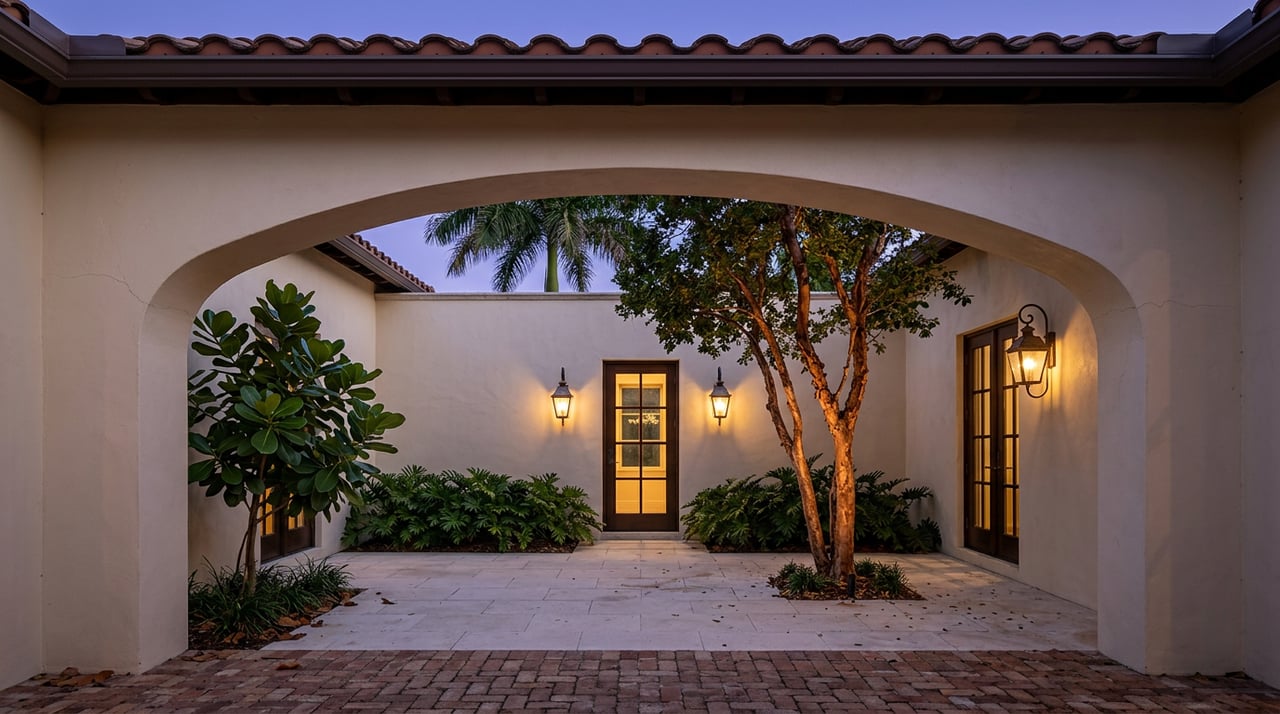
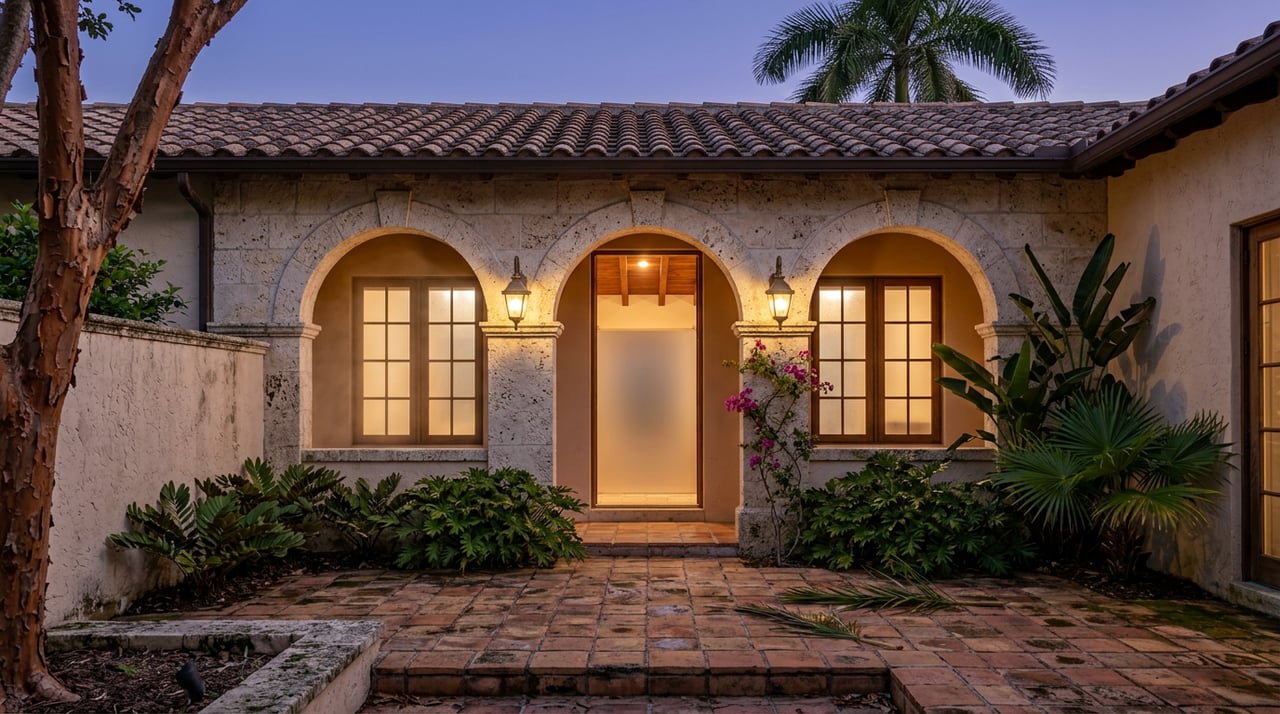
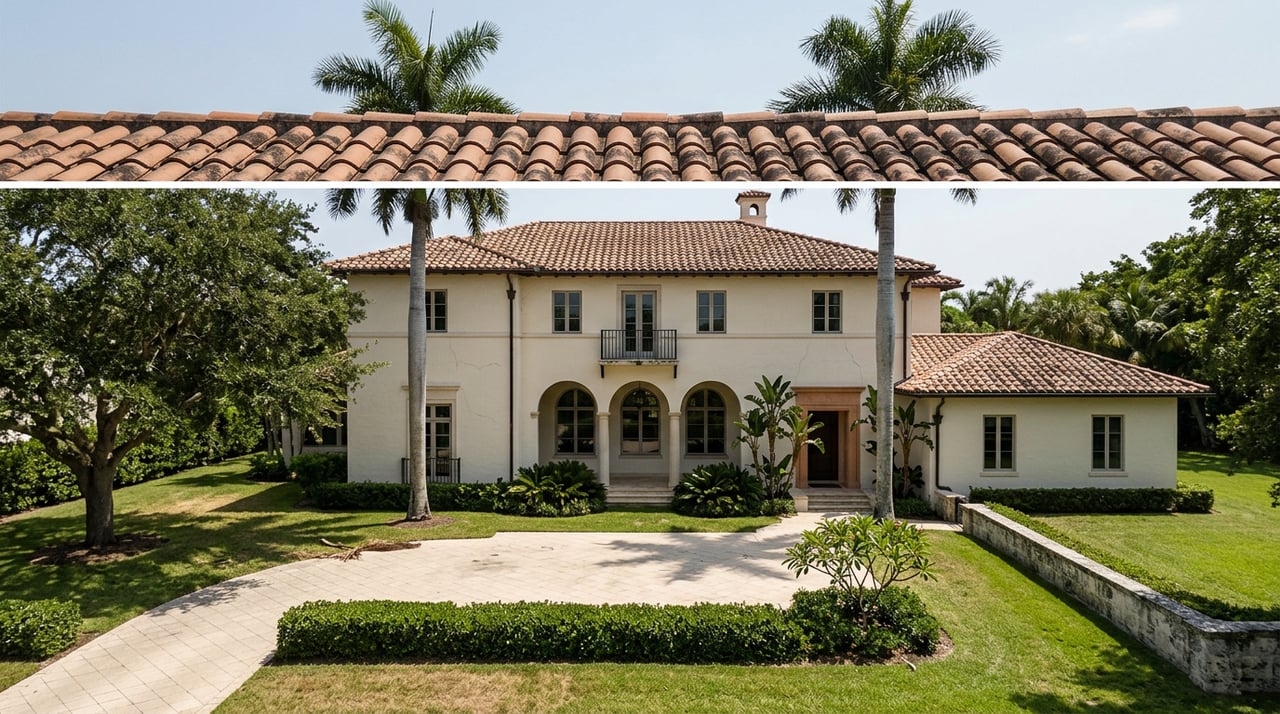
For a Landmark or a Contributing property, a roof replacement is exterior work, and exterior work on a designated property requires a Certificate of Appropriateness before the city will issue a building permit. That review looks at whether the new roof matches the old one in material (clay barrel tile generally has to come back as clay barrel tile), color (earth tones and terra cotta over anything bright or unusual), and profile, since an S-tile roof and a true barrel tile roof read differently on a Mediterranean Revival facade. Front-facing solar panels are a frequent point of denial for the same reason.
Some of that review happens at the staff level for straightforward repair-in-kind work. A full replacement or anything that deviates from what was originally there is more likely to need the board itself, which meets the third Wednesday of each month at Coral Gables City Hall, 405 Biltmore Way. That meeting date is the pace-setter, not the contractor's schedule.
Two Clocks, Two Paces
| The Insurance Clock | The Preservation Clock | |
|---|---|---|
| Starts ticking | Roof passes 15 years, sooner for some materials and carriers | The moment a home is designated Landmark or Contributing |
| Sets the pace | Underwriting guidelines, which shifted favorably in 2026 | The Historic Preservation Board's monthly hearing calendar |
| Moves faster with | A clean wind mitigation report and a passed four-point inspection | An early call to Historical Resources before pricing the job |
| Stalls on | Visible roof deterioration | A material substitution request or an incomplete submission |
Where the Two Clocks Collide
Picture a Coral Gables seller whose clay barrel tile roof is 17 years old. It has never leaked. It looks the way it did the day it was laid. None of that changes what happens once a buyer's lender orders the four-point and wind mitigation inspections that come standard on a purchase this size. If the carrier flags the roof, the buyer's financing timeline now depends on a repair or replacement happening on a schedule set by a closing date, not by a board agenda.
That is where a Contributing property behaves differently than the same house in an unincorporated part of Miami-Dade. Before pricing anything, the first call has to go to the city's Historical Resources & Cultural Arts Department at 2327 Salzedo Street, to confirm exactly what level of review the project triggers. If it needs a full board hearing rather than a staff sign-off, the earliest available slot might be a month away. Once approved, the work itself costs more: re-roofing labor on a Coral Gables historic home typically runs 25 to 40 percent higher than the same square footage in a newer neighborhood, largely because century-old plank decking rarely meets current Florida Building Code and has to be reinforced or replaced before new tile goes down.
None of this is a defect in either system. The insurer's rule protects against a roof that might fail in a storm. The city's rule protects the architectural character that made the house worth buying in the first place. The friction shows up only when a transaction tries to move at a pace neither system was built for.
One Detail Owners Often Get Backwards
Two pieces of information are worth separating clearly, because they get confused often enough to cause real anxiety.
The first is Miami-Dade's 40-year building recertification program, the safety inspection requirement that expanded after the Surfside condominium collapse. It applies to condominiums, cooperatives, and larger structures. Single-family homes and duplexes are explicitly excluded from that requirement under the county's own guidance. An owner of a 90-year-old Coral Gables house does not need to worry about a recertification notice arriving in the mail.
The second is the ad valorem tax exemption available to owners of locally registered properties who complete a qualifying rehabilitation under the Secretary of the Interior's Standards. That covenant with the city freezes the added property tax value from the improvement for up to ten years. It applies to restoration work, not routine replacement, so it is worth raising with the Historical Resources office before assuming a re-roof only adds cost with nothing offsetting it.
Before You List, or Before You Write the Offer
- Check the property's designation status at coralgables.com/historic before you plan any exterior project or price a purchase.
- Order both the four-point and wind mitigation inspections early, whether you are selling or buying, so the roof's real condition is documented before it becomes a closing-week surprise.
- If the home is Landmark or Contributing and the roof needs more than a patch, call the Historical Resources & Cultural Arts Department before you get contractor bids.
- Build the Historic Preservation Board's monthly meeting date into your timeline the same way you would a lender's underwriting window.
- Ask whether the planned work qualifies for the ad valorem exemption before assuming the higher labor cost is a pure loss.
A Few Questions Worth Settling Early
Does historic designation itself make a home harder to insure? Not directly. Insurers price the physical roof, the wiring, and the materials involved. What raises the cost on a designated Coral Gables home is usually the replacement value of coral rock walls and barrel tile roofing, not the designation label attached to the deed.
Does Florida's $7,500 exemption for small permits let me skip the design review? No. That threshold is a state building-permit exemption for minor cosmetic work. It has no bearing on Coral Gables' Certificate of Appropriateness requirement, which still applies to exterior work on a designated property regardless of the project's cost.
Will the 2026 insurance rate cuts change how fast I can get a roof approved? No. The rate environment affects what a policy costs once the roof is documented and compliant. It has no effect on the Historic Preservation Board's hearing schedule or the time needed to source tile in a matching historic profile.
If you are weighing a sale on a Contributing or Landmark property in Coral Gables, or writing an offer on one, the timing questions above are worth answering before the inspection period starts, not during it. Jane Gomez Mena, working alongside Laura Mullaney at Coldwell Banker Realty, has spent years walking Coral Gables sellers and buyers through exactly this kind of preservation-aware planning. Take a look at our sellers' guide or buyers' guide for more on preparing a historic property for market, or reach out directly to talk through where your home's roof sits on both clocks.